
At first scroll, it seems like pretty straightforward advice: “Leave the leaves.”
But as someone who might be a bit of an overthinker, sometimes a “simple” tip I see online leads me down a rabbit hole of questions about how to put it into action.
And soon, what started as “don’t worry about cleaning up the leaves” becomes a lot more complicated.
What if the grass is still growing and I need to mow?
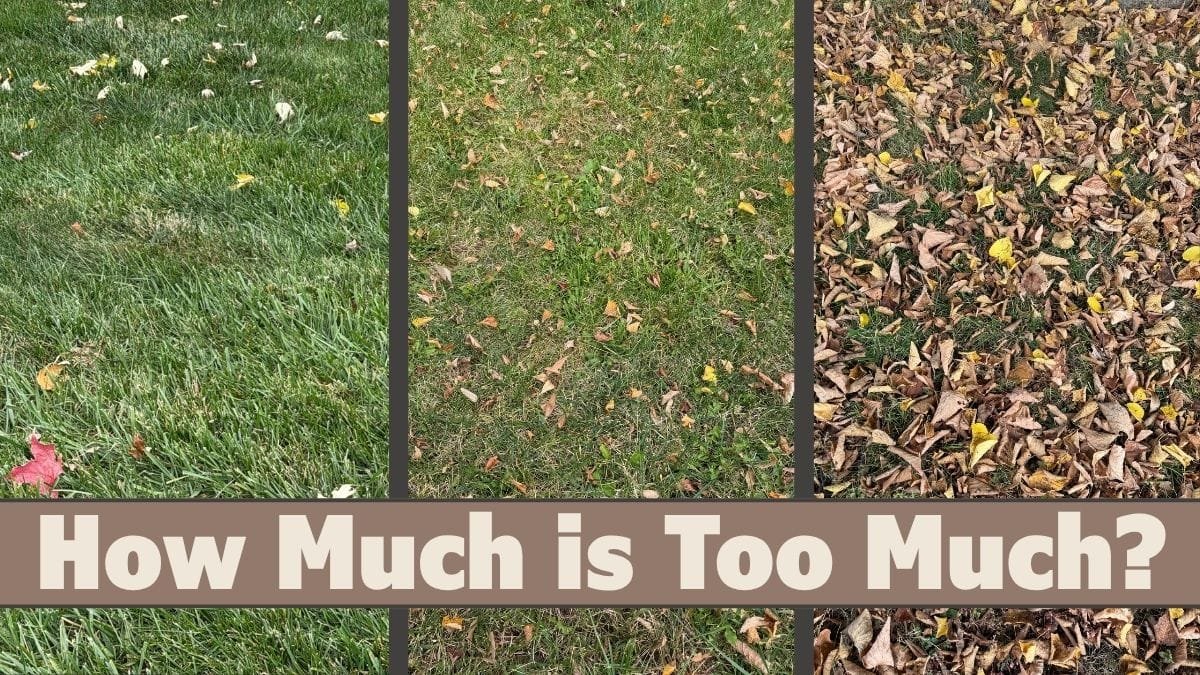
What if it’s like a blanket of color on my front lawn? Can I leave those? Or will they smother the grass underneath?
Spoiler alert: If you have a thick, matted blanket, they will.
So then what? How many can I leave? If I can’t leave them on the lawn, where am I supposed to go with them?
If you’ve heard the phrase “leave the leaves” and it leaves you a little confused, I’m here to answer some of the biggest questions I had and hopefully make it a little easier to adopt this philosophy in some form if you are able.
What to do when a beautiful gift becomes a mess?
While they’re on the trees, the leaves are breathtaking. Watching a single leaf cascade to the ground and land gently is a relaxing sight I look forward to each year.
And those colorful blankets of new-fallen leaves under trees and on lawns in my neighborhood are beautiful.
But like snow that turns gray and dirty in the winter, eventually the newness and fresh beauty fade, and a dry, dull brown or gray wins out.
For many people, this image prompts the urge to start tidying up like the neighbor next door:
Rake ’em, bag ’em, and send them to the curb.
Why leave the leaves?
They may look like an eyesore on our lawns — which we’ve been trained to keep uniform, neat and tidy for decades — but what is ugly to us hides something much more beautiful at its core.
In the wintertime, those ugly, “purposeless” dead leaves provide shelter for the living on the coldest nights of the year, a cozy place for overwintering insects and future pollinators that will be born in the spring, and food for our nutrient-hungry soil.
For years, perhaps we didn’t know – or maybe we had forgotten – the benefits of these too-long-neglected essential players in our ecosystem.
With more awareness about disappearing wildlife, global warming, and fewer supplies of natural resources, more recently we have looked for ways that we can do something to help the Earth, animals, and plants we love.
“Leave the leaves” empowers the everyday person with something concrete and actionable they can do to make an impact.
How do I leave the leaves? (Yes, really.)
In my small yard, I have one large deciduous tree, a honey locust. And though it sheds its leaves, they are tiny compared to those of many more broadleaved trees like maples or oaks.
So when it comes to the leaves in my yard, I truly can leave them where they fell.
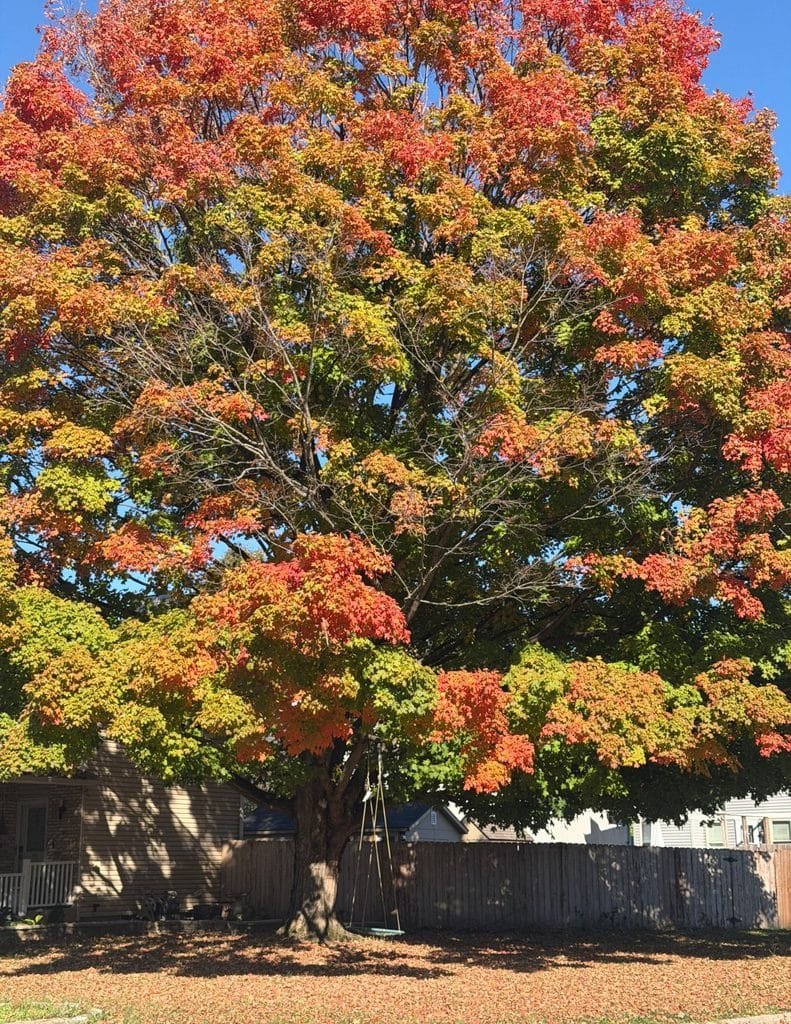
I realize many are not so lucky. My friend down the street has the most beautiful fall tree in the neighborhood. I have tried many times to photograph it, and I can never seem to do it justice.
A couple of years ago for her son’s birthday party, her family made a huge leaf pile in their yard and around eight kids were all jumping and having a great time hiding in the large, deep leaf pile at the same time.
Toward the end of the party, my friend mentioned the cleanup.
Not fully understanding the advice, I said something like, “Maybe you could just leave them. They are beautiful, and they’re always saying to ‘leave the leaves.’”
But if you leave a 2-ft-deep, massive pile of leaves on your lawn all winter long, guess what you will find underneath in the spring?
Not grass.
Probably not what most in suburbia are looking for.
I have since learned that there is definitely a point at which some of the leaves will indeed not be able to be left. Or at least not left where they fell.
How many leaves can I leave?
Fortunately, you do not need to remove every leaf from your lawn! (And if you know me, you know I am “all about” minimizing unnecessary yardwork and going out to “play” in nature instead.)
Unfortunately for overthinkers like me, there’s no guide (at least that I could find!) with a correct, single measure of leaves that works for every yard.
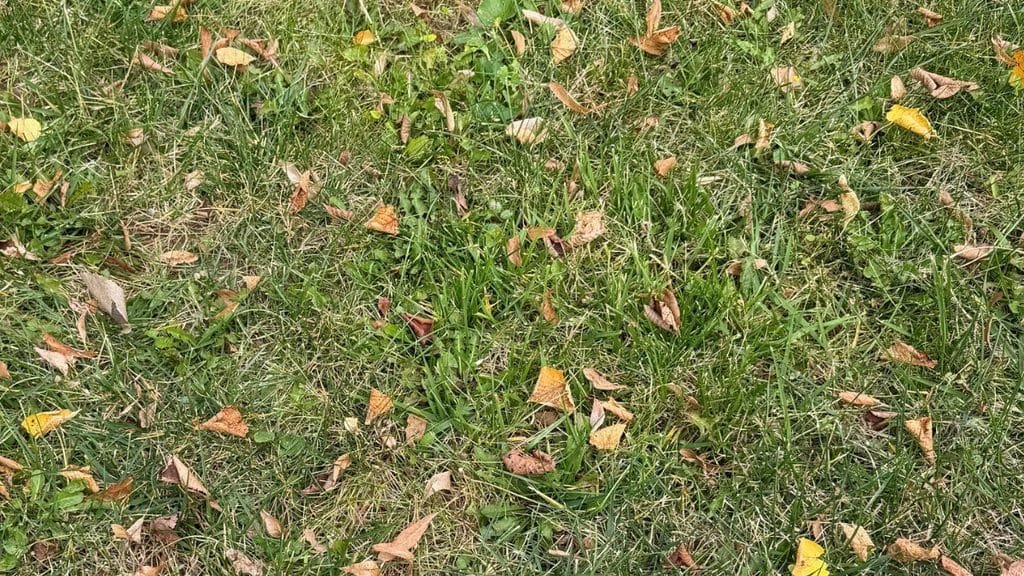
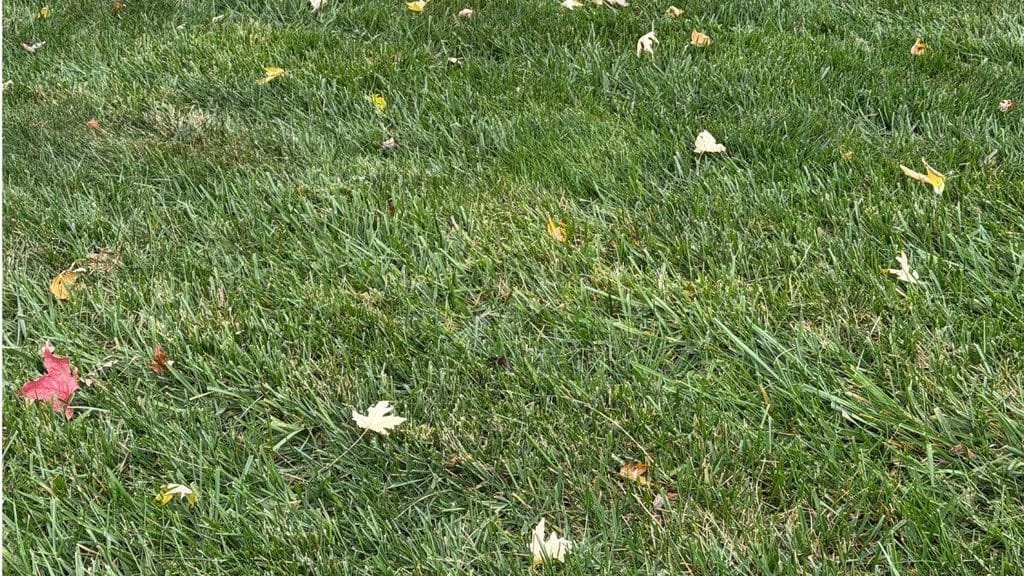
But after reading more than a couple of articles in my research, I feel comfortable saying a light scattering of leaves generally will not hurt your grass.
The key is to ask yourself two questions:
1. Is plenty of green grass still visible?2. Are the leaves scattered loosely, rather than forming a dense, matted layer?
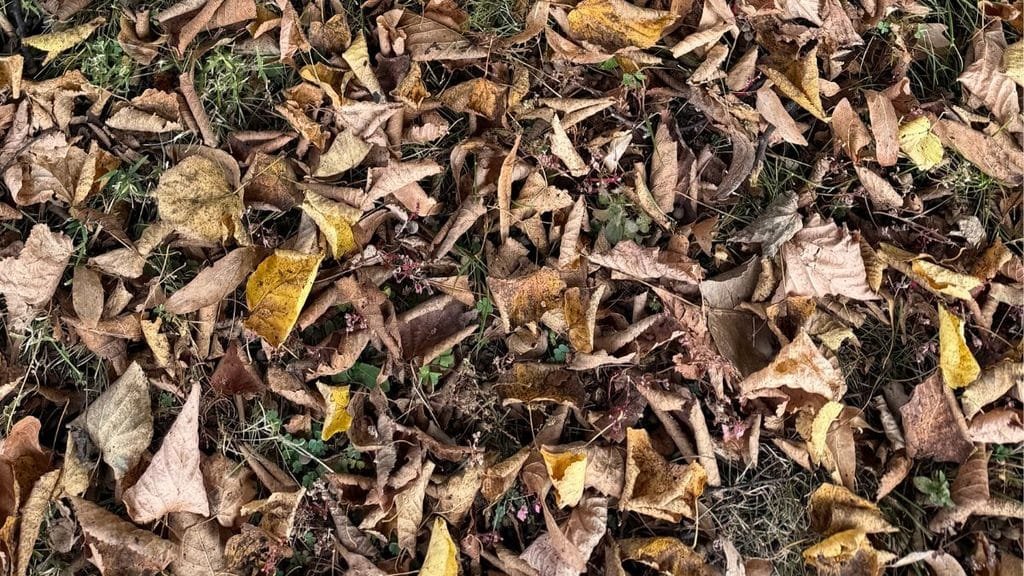
If leaves begin to accumulate in thick layers – blocking sunlight and potentially trapping moisture against the grass – that is when you might need to perform a little light “intervention.”
So what should you do with them? Where do you put them all, and how do you get them there?
Rake, blow, or mow?
Remember when I mentioned that things seem like they are almost always more complicated than we think at first? Besides the mistaken advice regarding my friend’s leaf pile, I continue to learn something new the more I investigate.
If your primary goal is to enrich your soil, and your yard is not an entire blanket of tightly packed leaves, you can probably just run them over with your mower.
And this is what I have done for the last couple of years.
We do not bag when we mow, so things just get chopped up and put right back into the lawn.
However, because my main goal is assisting wildlife, instead of mowing over those bigger, broad leaves that inevitably do blow into my lawn from my neighbors’ trees during the season, I would do better to rake or gently blow them. Insects like luna moths use those fallen leaves to camouflage their cocoons.
Mowing those leaves might mean I’m mowing something I did not intend to chop in my cleanup.
Big leaves have been falling here for a while, and some had definitely gathered in my lawn prior to a recent weekend, when I needed to mow. Daytime temperatures had still been hitting the 70s, so the grass continued to grow at a pretty decent rate.
Before mowing, I was faced with the decision to either rake the leaves off to the side somewhere or chip them as I mowed the lawn.
I chose to relocate what I could, and I did my best to rake and gather some of the scattered big leaves into a few small piles across the lawn. From there I scooped up the piles and moved them into a nearby garden bed.
Perhaps I did more than I needed to, but fresh off of researching for this article, I was extra aware and decided to go for a middle ground.
If you need to mow or have so many leaves that you can’t leave them all winter, and your primary goal is to help wildlife (as opposed to improving soil quality), gently raking or blowing those leaves is less disruptive than mowing and shredding them.
Where to go with all those leaves?
If you can’t leave them where they are, there are a few things you can do with your leaves.
Use them as mulch in any garden beds you may have. Standard advice recommends keeping the layer no more than a few inches deep.
As you redistribute them, try to allot some space around the trunks and stems of any existing trees, shrubs, or plants to avoid creating too much moisture buildup.
The great thing about using leaves in your beds is that they are a free, organic, sustainable mulch that will help various species throughout the winter, moderate soil temperatures, reduce the need for a store-bought mulch product, and improve your soil quality over time.
Another great option is to rake the leaves under trees and shrubs. These tend to be areas that don’t get quite enough sun for lush grass to grow, so it is likely that grass is thinner or nonexistent here anyway.
A third option is to pile the leaves in an out-of-the-way, designated area. This technique can be combined with other sustainable habits, too, like creating your own leaf mold.
Fourth, if you know anyone looking for leaves to compost – friends, family, or local garden centers – tell them to feel free to come over and grab what they want!
Bonus benefit? This might even help with your cleanup efforts.
Where should I not leave the leaves?
I love the look of leafy sidewalks in the fall. However, man-made walking surfaces like sidewalks, walkways, and driveways should be cleared of leaves. They can become quite slippery when wet.
Other areas to clear include street gutters and the area around storm drains. Heavy autumn rains and even melting winter snow need a clear path for proper drainage, and you will appreciate that you have kept these areas clear when inclement weather strikes.
If you own a house, cleaning gutters after the bulk of leaves have fallen can also improve drainage for rain and melting snow. It can also prevent gutters from becoming too heavy and pulling away from your home.
And speaking of seasons . . .
Last year around this time, I wrote a post about the difficulty that comes with trying to “do the right thing” by the Earth.
And here I am again as the leaves fall, wrestling with that same challenge.
I know that what starts as a simple idea often reveals itself to be a bit more complicated than we thought at first.
But perhaps the question isn’t what we should do with every leaf. Maybe it’s what we could do with some of them.
If you’re physically able — or have someone willing to lend a hand (pizza, anyone?) — I hope you will consider leaving at least some of the leaves this year.
After the gift of keeping our world green and our bodies cool all summer long, then turning striking colors and lightly cascading to the ground to form a blanket of colorful, crunchy goodness in the fall, perhaps we can let those leaves offer one more gift to the animals and earth at our feet during the coldest months of the year.
